


A promotion interview (also called an internal interview) is a job interview for a new role at the company you already work for. The panel already knows your work, so they focus on three things: the results you have delivered, whether you can operate at the next level, and how you will handle the move, for example managing former peers.
Below are 68 promotion and internal interview questions grouped by theme, each with a sample answer you can adapt, plus a preparation plan, questions to ask the panel and what your manager may be asked about you.
Key takeaways
- Prepare 5 to 6 short stories with numbers (results, a failure, a conflict, a time you led without authority) and reuse them across questions.
- Answer "Why should we promote you?" with evidence from your current role and a clear plan for the first 90 days.
- Expect the panel to check your answers with your current manager, so keep your stories consistent with your track record.
- Talk to your manager before you apply, and have a calm answer ready for "What will you do if you don't get the role?"
How a Promotion or Internal Interview Is Different
An internal panel already has a picture of you from your daily work. Your job is to build on that picture, not to assume it speaks for itself.
- Your track record is evidence. Past results and your reputation are being assessed alongside your answers, so consistency matters.
- Ambition has to sound like contribution. Interviewers want to see that you want to grow, without leaving your current team in trouble. Frame the move as a way to contribute more.
- Changing relationships come up. Expect questions about managing former peers or earning authority in a new team.
- The bar on the next level is higher. Culture fit is assumed. What is tested is strategic thinking, leadership potential and judgment at the level of the new role.
How to Prepare for a Promotion Interview
- List your results. Write down your main achievements in the current role with numbers: time saved, revenue, quality, customer outcomes.
- Research the new role. Go beyond the job description. Talk to people on the team about their goals and current problems.
- Talk to your manager first. Tell them you are applying and ask for their honest view of your readiness. The panel will usually speak to them.
- Prepare your stories. Use the STAR format (Situation, Task, Action, Result) for 5 to 6 stories you can adapt to different questions.
- Draft a 30-60-90 day plan. A short, realistic plan answers "What would you do first?" and shows you are already thinking at the next level.
- Prepare for the obvious questions. "Why you?", "Why this role?" and "Why now?" need clear, confident answers.
Promotion Interview Questions About Performance & Achievements
1. What accomplishments are you most proud of in your current role?
“I’m proud that I reduced onboarding time for new clients by 20%, which meant we reached our quarterly targets two weeks early.”
2. How have you exceeded expectations in this role?
“Beyond my targets, I created a reporting template that the whole team now uses, it cut our weekly prep time by 3 hours.”
3. What impact have you made for the company so far?
“I’ve helped retain three of our largest clients by building stronger check-in processes and improving response times.”
4. How have you improved processes in your team?
“I introduced a ticketing system for requests that eliminated confusion and helped us prioritize effectively.”
5. How have you grown since starting this position?
“I’ve grown from being task-focused to outcome-focused. I now think in terms of impact on the business, not just completion.”
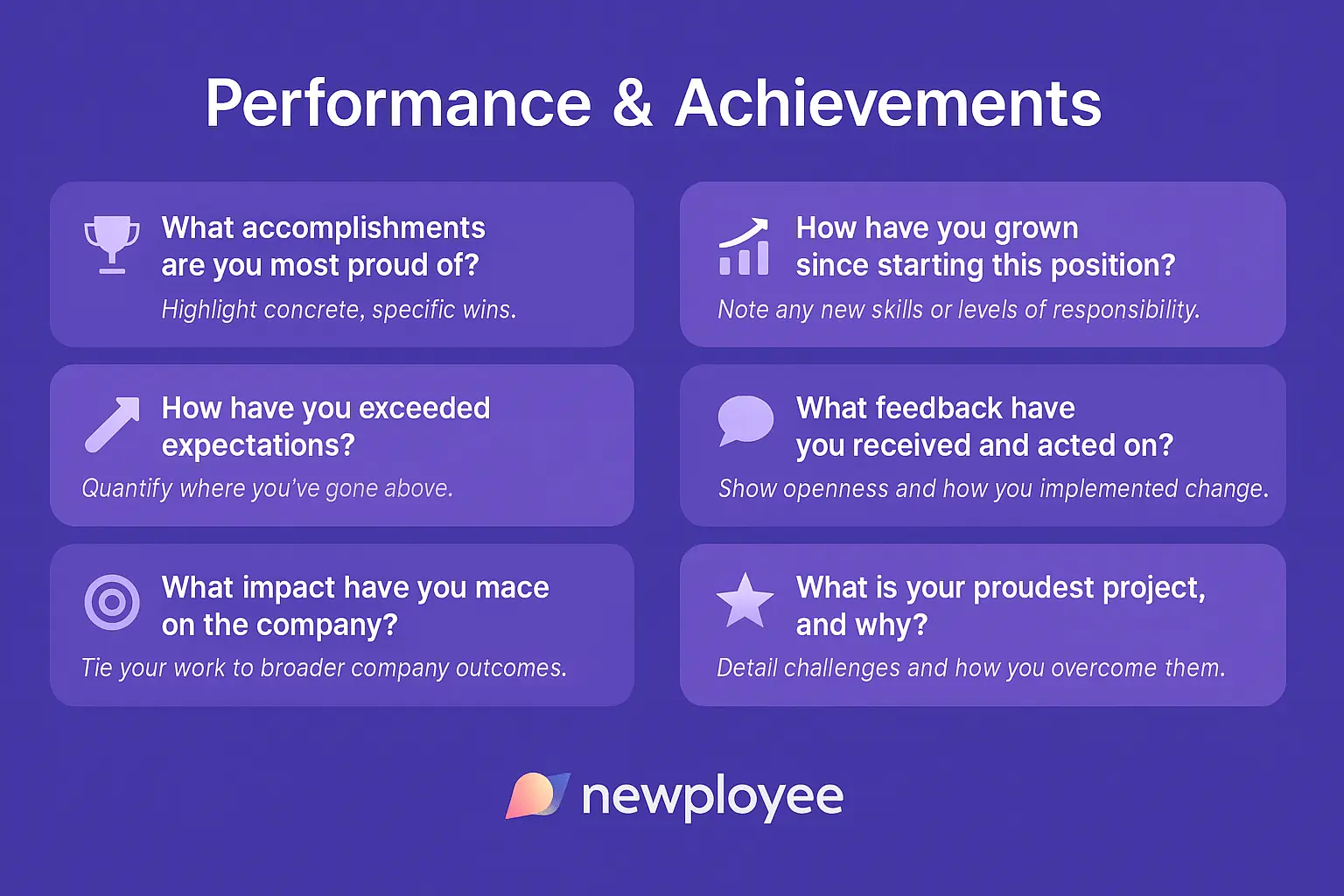
6. What feedback have you received and acted on?
“I was told my presentations were too detailed. I started using executive summaries, and leadership feedback improved immediately.”
7. What’s your proudest project, and why?
“Launching the client knowledge base, it cut support requests by 25% and gave me experience in cross-team collaboration.”
8. Which goals did you hit (or exceed) last year?
“I exceeded my sales quota by 18% while keeping churn below 3%.”
9. Which goals did you miss, and why?
“I missed my upsell target by 5%. I realized I needed earlier conversations with clients, I’ve already adjusted my approach.”
10. How do you measure your success at work?
“By whether my work makes things easier for others, not just whether I finish tasks.”
Promotion Interview Questions About Leadership & Teamwork
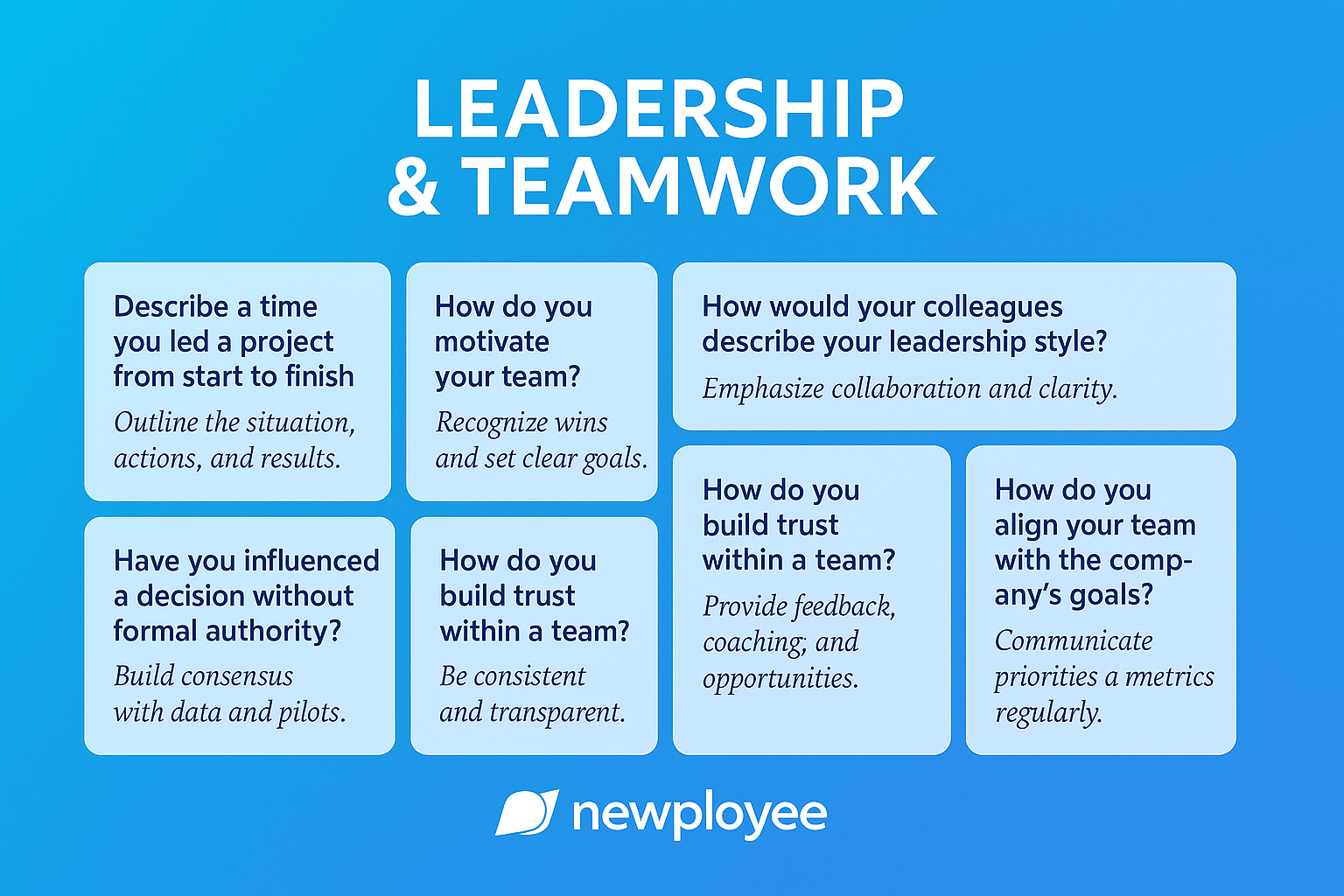
11. Can you describe a time you led a project from start to finish?
“I led the rollout of our new CRM. It was delivered on time and within budget, and adoption hit 95% in the first month.”
12. How do you motivate teammates during crunch time?
“I focus on clear communication, celebrate small wins, and ensure that everyone feels their contribution matters.”
13. How would your colleagues describe your leadership style?
“Collaborative and supportive. They know I’ll back them up, but I also hold them accountable.”
14. How do you resolve conflicts on your team?
“I listen to both sides, identify the real issue, and work toward a solution everyone can support.”
15. Have you ever influenced a decision without formal authority?
“Yes, I convinced leadership to adopt a new tool by running a small pilot that proved its value.”
16. Have you mentored or trained colleagues? What did you learn?
“I’ve trained two new hires. It taught me that explaining things clearly makes me better at my job too.”
17. How do you balance delegating vs. doing things yourself?
“I delegate tasks that grow others’ skills, but I take on critical tasks where accountability falls on me.”
18. How do you handle it if a teammate resists your direction?
“I ask questions to understand their concerns, then explain the reasoning and adjust if needed.”
19. What role do you usually play in group projects?
“I often act as the organizer, keeping tasks aligned and ensuring nothing falls through the cracks.”
20. How do you ensure quieter teammates get heard?
“I make space for them in meetings by asking their opinions directly and following up one-on-one.”
21. How do you build trust within a team?
“Consistency and transparency. I share information openly and keep my promises.”
22. What’s one example where you supported a struggling teammate?
“I noticed a colleague falling behind on deadlines. I offered to help re-prioritize tasks and coached them on time management.”
Promotion Interview Questions About Strategic Thinking & Vision
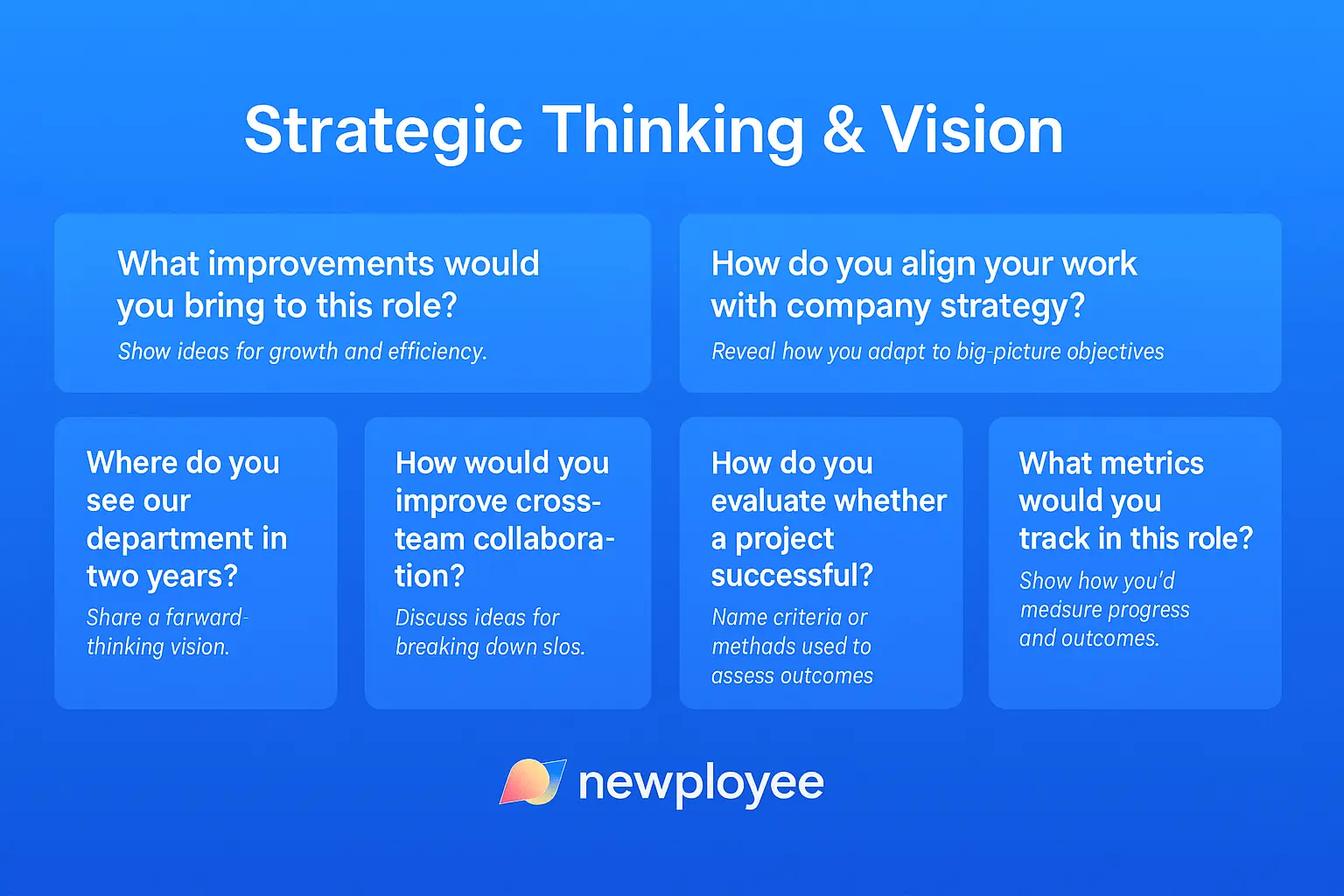
23. What improvements would you bring to this new role?
“I’d focus on improving cross-department workflows, which would cut handover delays by at least 15%.”
24. What’s your 90-day plan if promoted?
“First 30 days: listen and observe. Next 30: align with leadership priorities. Final 30: implement one impactful change.”
25. How do you align your work with company strategy?
“I tie my personal goals to our OKRs and regularly check if my work supports revenue or retention.”
26. Where do you see our department in two years?
“Becoming a strategic partner to other teams, not just a support function.”
27. How do you prioritize when everything feels urgent?
“I ask: Which tasks directly affect revenue, clients, or deadlines? Those get priority.”
28. How would you improve cross-team collaboration?
“By creating shared dashboards so every team sees progress in real time.”
29. How do you handle projects with limited resources?
“I break them into phases and secure quick wins to justify more investment later.”
30. How do you approach risk-taking in business decisions?
“I weigh potential impact vs. probability, then test small before rolling out big.”
31. What would you do differently from your predecessor?
“I’d set clearer performance metrics so the team knows what success looks like.”
32. What role should this department play in company growth?
“We should be an enabler providing tools, insights, and processes that accelerate other teams.”
33. How do you identify opportunities for innovation?
“By listening to clients’ pain points and spotting repetitive frustrations internally.”
34. How do you evaluate whether a project is successful?
“Did it meet the KPIs, and did it make people’s work easier? Both matter.”
35. What metrics would you track in this role?
“Efficiency gains, employee engagement scores, and how our work ties to revenue.”
For HR teams managing internal promotions
Newployee helps HR teams structure internal role transitions with handover tasks, manager alignment, access updates, and 30-60-90 day milestones.
Promotion Interview Questions About Self-Awareness & Growth
36. What skills do you need to develop for this role?
“Advanced financial forecasting. I’ve already started an online course to strengthen it.”
37. How do you keep learning outside of work?
“Podcasts, LinkedIn communities, and online certifications I dedicate two hours weekly.”
38. Tell us about a failure you’ve had and what you learned.
“I missed a deadline early in my career because I didn’t delegate. It taught me to trust my team.”
39. How do you handle stress and high-pressure situations?
“I stay calm by breaking big tasks into small steps and focusing on progress.”
40. What motivates you to do your best work?
“Seeing my work create measurable impact motivates me more than anything.”
41. What kind of leadership do you thrive under?
“Leaders who give clear direction but trust me to own execution.”
42. How do you give constructive feedback?
“I frame it around impact. ‘Here’s how this affects the team, and here’s what could work better.’”
43. How do you receive constructive feedback?
“I take notes, ask clarifying questions, and apply it right away to show I value it.”
44. What’s your biggest professional weakness?
“I can be impatient with slow processes. I’m working on channeling that into process improvement.”
45. What strengths make you ready for promotion?
“Strategic thinking, ability to mentor, and proven delivery under pressure.”
Promotion Interview Questions About Commitment & Cultural Fit
46. Why do you want this promotion?
“Because I want to amplify my impact; not just doing the work, but guiding the direction.”
47. Why should we promote you over external candidates?
“I already know the culture, the people, and the challenges. I can hit the ground running tomorrow.”
48. How have you demonstrated company values?
“By always putting customers first, even if it meant late nights to deliver on a promise.”
49. What do you think is the biggest challenge facing our team?
“Scaling our processes without losing quality. I’ve already identified three ways to streamline.”
50. How would you handle staying in your current role if not promoted?
“I’d stay committed, ask for feedback, and work on the gaps for next time.”
51. What keeps you committed to this company?
“The growth opportunities and the people. I feel invested in our long-term vision.”
52. How do you contribute to a positive workplace culture?
“I celebrate others’ wins and make sure everyone feels included in conversations.”
Scenario-Based and Behavioral Promotion Interview Questions
53. A peer you manage used to be your equal. How do you establish authority?
“By respecting their expertise, setting clear expectations, and earning trust rather than demanding it.”
54. You notice a team member isn’t pulling their weight. What do you do?
“I’d have a private conversation, understand the root cause, and create an improvement plan.”
55. Senior management rejects your proposal. How do you respond?
“I’d ask for feedback, refine my approach, and present a stronger case.”
56. You’re promoted, but resources don’t increase. How do you succeed?
“I’d prioritize ruthlessly and automate wherever possible to maximize output.”
57. You’re asked to manage a project outside your expertise. What’s your approach?
“I’d quickly learn the basics, surround myself with subject experts, and focus on leading the process.”
58. You get the promotion, what will your first big win look like?
“Launching a cross-team initiative that saves time and demonstrates immediate impact.”
More Internal Interview Questions for a Move to a New Team
These questions come up when the new role is in a different team or department, not only a step up in your current one.
59. Why are you interested in this specific internal role?
“The role combines two things I already do well, working with customers and improving our processes, and adds the planning work I want to grow into. I've led two process changes in my current team, and this role lets me do that across the whole department.”
60. What does this role offer that your current one doesn't?
“More strategic planning. In my current role I execute the plan; here I'd help shape it. I'm not leaving because of anything missing in my team, I've simply mastered my current responsibilities.”
61. What does your current manager think about you applying?
“I talked to my manager before applying. They support the move, and we've agreed a handover plan so the team isn't left with gaps.”
62. How does your experience in your current department help you in this role?
“I know how our customers buy and where deals stall, because I've supported the sales team for two years. That will help me prioritize the work in this role on what actually moves revenue.”
63. How would you build credibility with a new team?
“By listening first. I'd meet each person, learn what slows them down, deliver on a few small promises quickly and let my results build trust rather than my title.”
64. How do you adapt your communication style to different people?
“With engineers I focus on specifics and data. With leadership I start with the impact and the decision I need. The content is the same; the order and the level of detail change.”
65. Describe a successful cross-functional project you worked on.
“I coordinated a pricing update with sales, finance and product. I set up one shared tracker and a weekly 15-minute check-in, and we launched on time with no billing errors.”
66. How does this role contribute to the company's strategy?
“This team turns customer feedback into product priorities. If we do that well, retention goes up, and retention is one of the company's main goals this year.”
67. What do you admire about how this team works today?
“How quickly you test ideas. You run small experiments before committing budget, and that's an approach I want to learn from and bring to the role.”
68. If you had to cut 10% of the team's budget, how would you approach it?
“I'd review every cost against the team's goals, cut tools and work with the lowest return first and look for efficiency gains before touching anything that affects the team's capacity.”
Questions to Ask in a Promotion Interview
Asking good questions shows that you are already thinking about the job. Pick two or three:
- What does success look like in the first 90 days in this role?
- What is the biggest challenge the team faces that this role should help solve?
- How will this role's performance be measured after the first year?
- What support is available while I hand over my current responsibilities?
- What would make you hesitate about promoting an internal candidate into this role?
What Your Manager May Be Asked About You
In an internal process, the hiring manager usually speaks to your current manager. Knowing the likely questions helps you keep your story consistent:
- Performance: "What is a notable achievement of this employee?" or "How do they handle tight deadlines?"
- Teamwork: "How do they work with colleagues and other teams?"
- Growth: "How do they respond to feedback?" or "Can you share a time they learned from a mistake?"
- Leadership potential: "Where have they shown leadership, with or without a title?"
If you mention a major achievement in the interview, your manager should be able to confirm it.
If You Don't Get the Promotion
Ask for specific feedback on what was missing, agree two or three development goals with your manager and set a date to review progress. Stay fully committed in your current role: how you handle the decision is often remembered when the next opportunity opens.
Promotion Interview Questions: FAQ
Most promotion interviews cover your results in your current role, leadership and teamwork, strategic thinking about the new role, self-awareness and growth, and scenarios such as managing former peers. Expect "Why should we promote you?" and "What would you do in your first 90 days?" in almost every promotion interview.
Give two or three results from your current role with numbers, connect them to what the new role needs, and add one concrete thing you would improve early on. For example: "I've already led our CRM rollout and cut reporting time by 3 hours a week, and in this role I'd apply the same approach to cross-team handovers."
Not usually. The panel knows your strengths and your weak spots, and they compare you with external candidates. Your advantage is that you can give specific examples from the company and show you can start contributing immediately.
List your achievements with numbers, research the new role by talking to the team, tell your manager you are applying, prepare 5 to 6 STAR stories and draft a short 30-60-90 day plan.
Ask what success looks like in the first 90 days, what the team's biggest challenge is, how the role's performance will be measured and what support you will have while handing over your current work.
Final Thoughts
The trick to promotion interviews is simple: don’t wait until you get the role to act like you’re in it. Use these questions and sample answers as a guide, but make them your own with real stories and numbers. If you balance confidence with humility, you’ll walk out of that room looking less like a candidate and more like the obvious choice.