


A skip-level meeting is a one-on-one or small-group conversation between a leader and an employee who reports to one of that leader's managers, skipping the level in between. Its purpose is to hear directly from the people doing the work, build trust across levels and spot problems early, not to review the employee or check up on their manager.
Most leaders hold them about twice a year with each person, for 30 to 45 minutes. This guide covers what a skip-level meeting is and is not, how to run one step by step, a 30-minute agenda template, starter questions and the mistakes to avoid.
Key takeaways
- Brief the middle manager before you start, so the meeting is not seen as an audit of them.
- Spend most of the time listening. The leader's job is to ask, not to present.
- Keep what people say confidential and share only themes with their manager.
- Follow up with visible action. Feedback with no response does more harm than not asking.
- Meet everyone on a regular cadence, not only high performers or people with complaints.
What a Skip-Level Meeting Is (and Is Not)
A skip-level meeting is:
- A listening session to hear unfiltered feedback from the front line.
- A way to show employees that leadership values their view.
- A health check on culture, workload and processes.
- A source of ideas from the people closest to customers and daily work.
- An early warning for problems that could lead to resignations.
A skip-level meeting is not:
- A performance review of the employee.
- An audit of their manager, or a way to go around them.
- A place to settle individual complaints.
- A presentation by the leader; the leader should mostly listen.
- A promise to fix every issue on the spot.
Why Skip-Level Meetings Matter
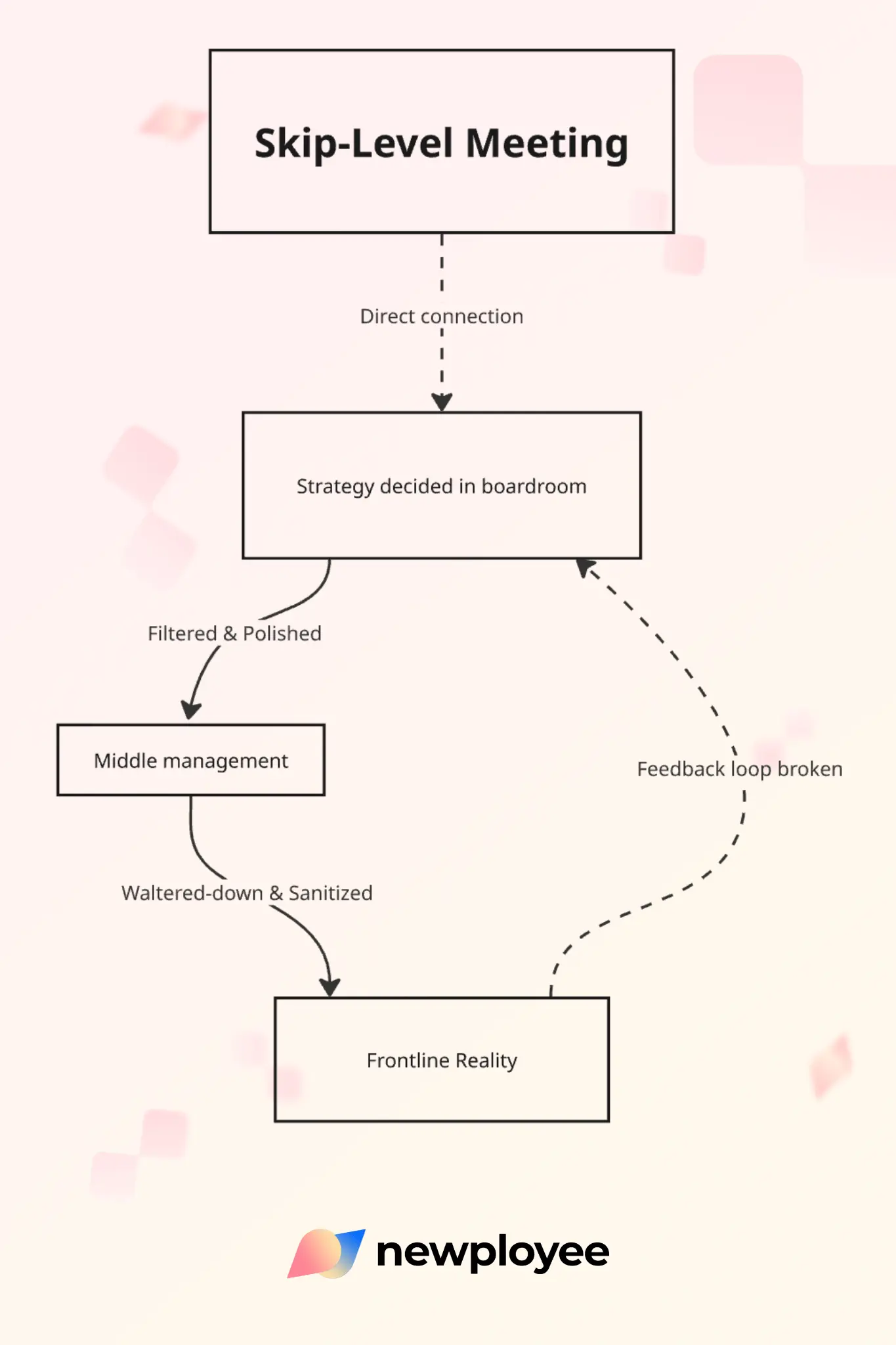
Information gets filtered as it moves up a hierarchy. Managers may soften or summarise feedback with good intentions, and senior leaders end up deciding with an incomplete picture. A skip-level meeting gives leaders a direct view of daily work.
- Earlier warning signs: leaders hear about workload, process or tooling problems before they turn into resignations.
- Better managers: themes from skip-levels show where managers need support. Gallup estimates that managers account for at least 70% of the variance in team engagement, so manager quality matters.
- Trust across levels: employees see that leadership wants to hear from them, not only from their manager.
- Ideas from the front line: people closest to customers and processes often know the simplest fixes.
- Talent visibility: leaders get to know people they rarely work with directly.
How to Run a Skip-Level Meeting in 6 Steps
1. Brief the manager first
Tell each middle manager what you are doing and why before anyone on their team is invited. Make clear it is not a review of them and that you will share themes, not names. You can use this script:
"We're starting skip-level meetings so leadership can hear directly how work is going across all teams. I'll be meeting people on your team over the next few weeks. This is not a review of you or your performance. I'll share the themes I hear with you afterwards, never who said what, and I'd like us to work on any follow-ups together."
2. Announce the program
Explain the purpose to the whole team in a short message or at an all-hands: what the meetings are for, how often they will happen and how feedback will be used. Say clearly that the meetings are confidential.
Invitation template:
Subject: Skip-level conversation with [Leader name]
Hi [Name], I'm meeting everyone in [department] for a 30-minute conversation over the next few weeks, and I'd like to hear how things are going for you. There's nothing to prepare and it isn't a performance review. I'll ask a few questions about your work, the team and what we could do better, and you can ask me anything. What you share stays between us; I'll only pass on general themes. Looking forward to it, [Leader name]
3. Set the cadence and format
Aim for about two meetings a year with each person, or quarterly if you have a small team. Keep them to 30 to 45 minutes. One-on-one meetings get more candid answers; small groups of three to five work when you have many people to cover. Rotate through everyone rather than picking people. For remote teams, use video with cameras on and do not record the call, so people speak freely.
4. Prepare
Send the invite with a clear, reassuring description, share two or three of the questions in advance and review what the person and their team work on. Decide how you will take notes; a notebook can feel less formal than a laptop.
5. Run the meeting
Start by restating the purpose and confidentiality, ask open questions, listen more than you speak and leave time for their questions. Avoid solving every issue on the spot; note it and say when you will come back.
6. Follow up and close the loop
After a round of meetings, group what you heard into themes, review them with the managers, agree owners and deadlines, and tell the teams what you are changing. This step is what makes the next round more honest.
Skip-Level Meeting Agenda Template (30 Minutes)
| Part | What to cover | Time |
|---|---|---|
| Welcome and purpose | Thank them, explain why you meet and confirm the conversation is confidential | 3 min |
| Getting to know them | Their role, what they are working on and what they enjoy | 5 min |
| Open questions | Team, processes, tools, communication and ideas (see questions below) | 15 min |
| Their questions | Anything they want to ask leadership | 5 min |
| Wrap-up | Thank them and say what happens next and when | 2 min |
For a 45-minute meeting, give the extra time to the open questions.
Skip-Level Meeting Questions to Start With
Pick four or five questions; you will not get through all of them in one meeting.
Getting to know them
- What are you working on right now that you're most excited about?
- What part of your job gives you the most energy?
- What would you like to learn or do more of in the next year?
Team and processes
- What gets in the way of doing your best work?
- If you could change one thing about how our team works, what would it be?
- What is a small change that would make a big difference to your day?
Support and communication
- Do you have what you need from your manager and from leadership?
- How clear are the company's priorities to you and your team?
- How could leadership communicate better with your team?
Ideas and the company
- What should we stop, start or keep doing as a company?
- What do customers tell you that leadership might not hear?
- Is there an idea you've had that never got picked up?
Culture and wellbeing
- How would you describe the mood on the team right now?
- Do people feel safe raising concerns or disagreeing?
- Is there anything that would make you think about leaving?
For more, see our skip-level meeting questions for leaders and employees. If you are the employee, read how to prepare for a skip-level meeting as an employee.
Is Your Organization Ready for Skip-Level Meetings?
Skip-level meetings can backfire in a culture of fear, because managers feel judged and employees do not speak honestly. Score each statement from 1 (not true) to 5 (very true):
- Psychological safety: employees can raise ideas or concerns without fear.
- Manager security: middle managers are open to feedback reaching leadership.
- Leadership openness: senior leaders are approachable and want to hear feedback.
- Feedback loop: employees see action after they share feedback.
- Trust: there is trust between different levels of the organization.
A total below 15 suggests starting with manager alignment and visible follow-up on existing feedback before launching skip-levels. A total of 15 or more means the conditions are in place.
Common Skip-Level Meeting Mistakes
- Skipping the manager briefing: managers feel bypassed and the program looks like an investigation.
- Turning it into a status update: the meeting is for the employee's perspective, not a project review.
- Talking too much: if the leader speaks more than about a fifth of the time, little is learned.
- Sharing individual comments: repeat themes, not who said what.
- Meeting only some people: picking favourites creates an in-group and skews what you hear.
- No follow-up: asking for feedback and doing nothing teaches people not to bother next time.
Skip-level meetings work best alongside regular anonymous feedback. Newployee's employee survey software helps you collect it from every team, not only the people you meet.
Skip-Level Meetings: FAQ
To give a senior leader a direct, unfiltered view of how work is going for employees two or more levels below them, build trust across levels and spot problems or ideas early. It is not a performance review of the employee or an audit of their manager.
A common cadence is about twice a year with each person, or quarterly for smaller teams. Consistency matters more than frequency: meet everyone on a predictable schedule rather than only when there is a problem.
Usually 30 to 45 minutes. Thirty minutes is enough for an introduction, four or five open questions, the employee's own questions and a short wrap-up.
No. The manager should be briefed in advance and receive the themes afterwards, but not attend, so employees can speak freely.
Yes. Use video with cameras on, keep the same agenda and confidentiality promise, and do not record the call so people feel free to speak.
They should be. Tell employees that you will share themes with their manager and leadership, but not who said what, and keep that promise.